
Most teams pick a satisfaction metric the way they pick a font: somebody used it before. The three common ones are not interchangeable. They ask about different things, on different timescales, and answer different questions.
CSAT: how was that?
Customer satisfaction is the simplest. “How satisfied were you with X?” on a scale, usually five points, reported as an average or as the percentage of people who picked the top two options.
It measures a moment: a support conversation, a delivery, an onboarding call. Ask it straight after the thing happened, while the memory is specific, and ask about the thing rather than about the company.
CSAT is the right metric when you own a process and want to know whether it is working this week. It is the wrong one for a relationship, because people are satisfied with a good interaction from a company they are about to leave.
The CSAT template is the short version of this.
NPS: would you put your name to us?
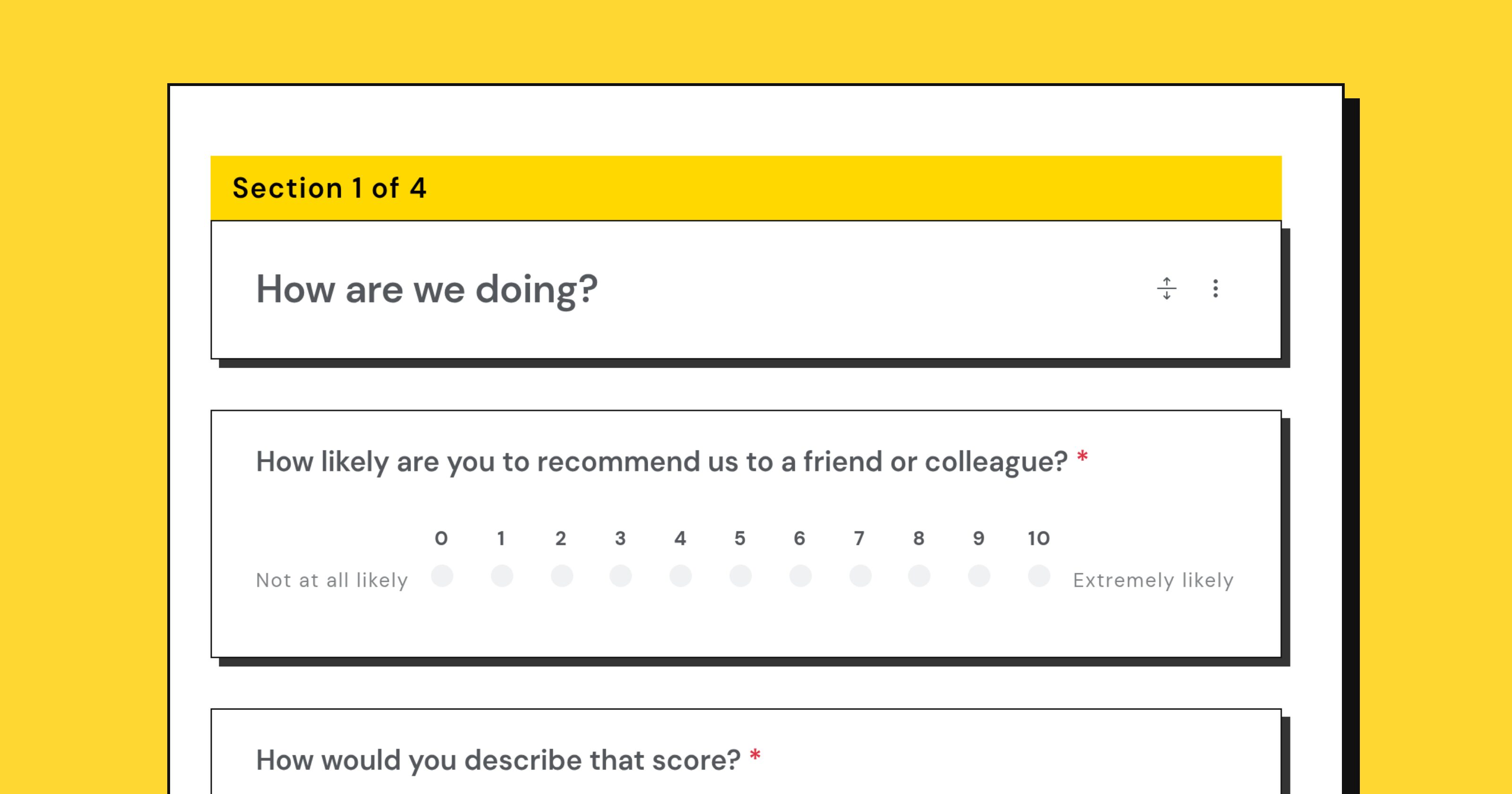
The 0 to 10 recommendation question measures a relationship, not an event, which is why asking it after a single support ticket is a category error.
Ask it at a sensible cadence of the same audience, and treat it as a slow indicator. The score is comparable across companies, which is its main practical advantage, and it is also the reason it attracts more gaming than any other number in the business. More on reading it in how to read an NPS score.
CES: how hard did we make this?
Customer effort asks how much work the person had to do: “how easy was it to get your problem resolved?” It is the best predictor of the three for the specific question of whether someone will come back after a support interaction, because effort is what people remember from a process.
It is also the most actionable, since the answer usually points at a step: they had to repeat themselves, chase, or find something that was not where it should be. Ask it after a resolved issue, not after a sale.
The question underneath the metric
Before picking one, write down the decision the number will inform.
- “Is this process working?” CSAT, asked immediately after the process.
- “Is the relationship healthy?” NPS, asked rarely, of a stable audience.
- “Why do people give up on us?” CES, after a support interaction.
- “What should we build next?” None of them. A metric cannot answer that, and a survey of what people say they want is weak evidence. Ask what they were trying to do and what got in the way.
Do not run all three
A form with an NPS question, a CSAT question and an effort question is a form that measures how patient your customers are. Pick the one that matches the decision, add one open question, and stop.
If you genuinely need two, run them separately, at different moments, to different samples.
Keep the wording still
Whichever you choose, the value is in the trend, and a trend only exists if the question, the scale, the audience and the timing hold still. Rewording a tracked question resets your history whether or not you notice.
Write it once. Put the experiments in the questions after it.
When the number stops being the point
All three metrics are summaries of something you could have read. If you have forty free-text answers a month and nobody is reading them, a better score will not help you. The metric is there to tell you when to go and read; it is not the reading.