
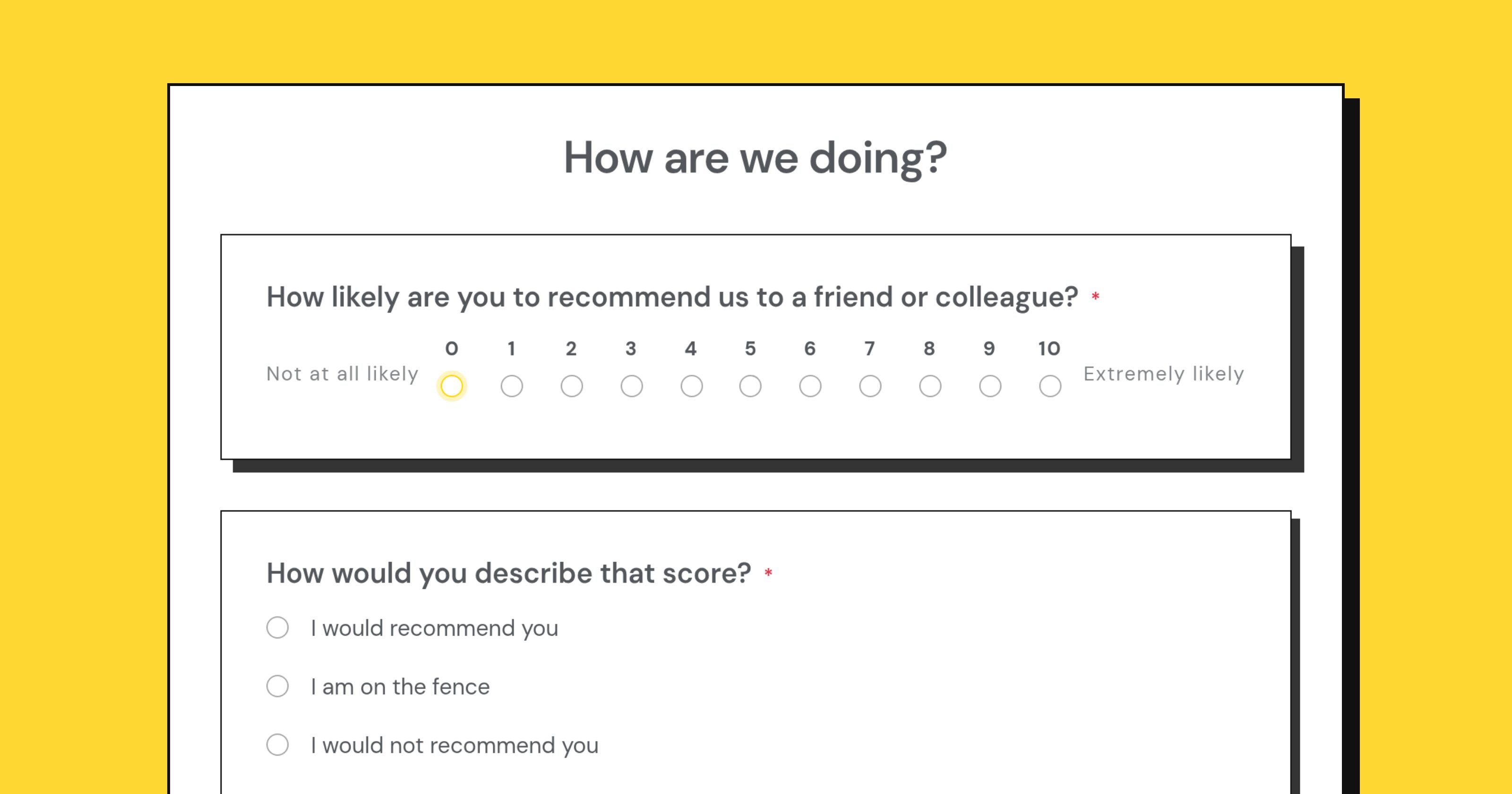
A rating scale is the cheapest question in a survey. It takes a second to answer, it produces a number, and a hundred of them produce a chart without anyone reading a word. That cheapness is also why scales are the questions most often wasted.
How many points
Five or seven for an opinion, eleven for a recommendation question, and nothing in between for no reason.
Five points is enough for most feedback: two bad, a middle, two good. Seven gives people room to be mildly something. Beyond that you are asking for a precision nobody has about their own feelings, and you will see it in the clustering on round numbers.
The 0 to 10 recommendation question is the exception, and only because the convention around it is fixed: the standard NPS split treats 9 and 10 as promoters, 7 and 8 as passives and everything below as detractors. If you shorten that scale, you cannot compare your score with anybody else’s, which was most of the point.
An even number is a decision, not a trick
A four or six point scale removes the midpoint and forces a lean. That is legitimate when you genuinely want a direction, and dishonest when the honest answer is “no strong feeling”. If a real middle exists, give it one.
Label the ends, and mean them
“1 to 5” with no words means a different thing to everyone. Label at least the ends, in plain language: “not at all useful” to “very useful”. Do not label 1 as “poor” and 5 as “world class”, because you have then stretched the top of the scale out of reach and squashed all your real variation into three points.
Keep the good end on the right in every question on the form. Flipping the direction to “catch people out” mostly catches people who were reading quickly.
Never reword a tracked scale
If you ask the same scale every quarter, the wording, the number of points and the labels are now part of your data. Change any of them and your trend line breaks, quietly: the number still moves, and you will attribute the move to your product instead of your editing.
Write the question once, put it at the top of the form, and leave it alone. Everything you want to experiment with goes in the questions after it.
A scale cannot route
This is the constraint that catches people out most often in Questionful. Conditional logic runs on multiple choice, checkboxes and dropdowns. A linear scale, a slider or a date cannot send someone down a different path.
It is a sensible constraint when you think about it, because “greater than 7” is a rule about numbers rather than a choice of answer, but it does mean a common survey plan has to change shape:
- What you wanted: rate us 0 to 10, and if you said 6 or less, tell us what went wrong.
- What works: ask the rating, then ask a short choice question beside it (“overall, was that a good experience?” with three or four options), and branch the follow-up on the choice.
You end up with one extra question and a form that actually routes. The scale still aggregates into the chart, and the choice question carries the logic.
Pair the number with one sentence
A scale tells you where you stand and never why. One optional paragraph question after the scale, worded plainly (“anything you would like to add?”), turns a moving average into something you can hand to whoever owns the problem.
Leave it optional. A required free-text box after a rating is the fastest way to lose the rating too.
What the number is for
A scale is a thermometer, not a diagnosis. Use it to notice that something changed, and use the questions around it to work out what. If you only have the number, you know the temperature and nothing else.